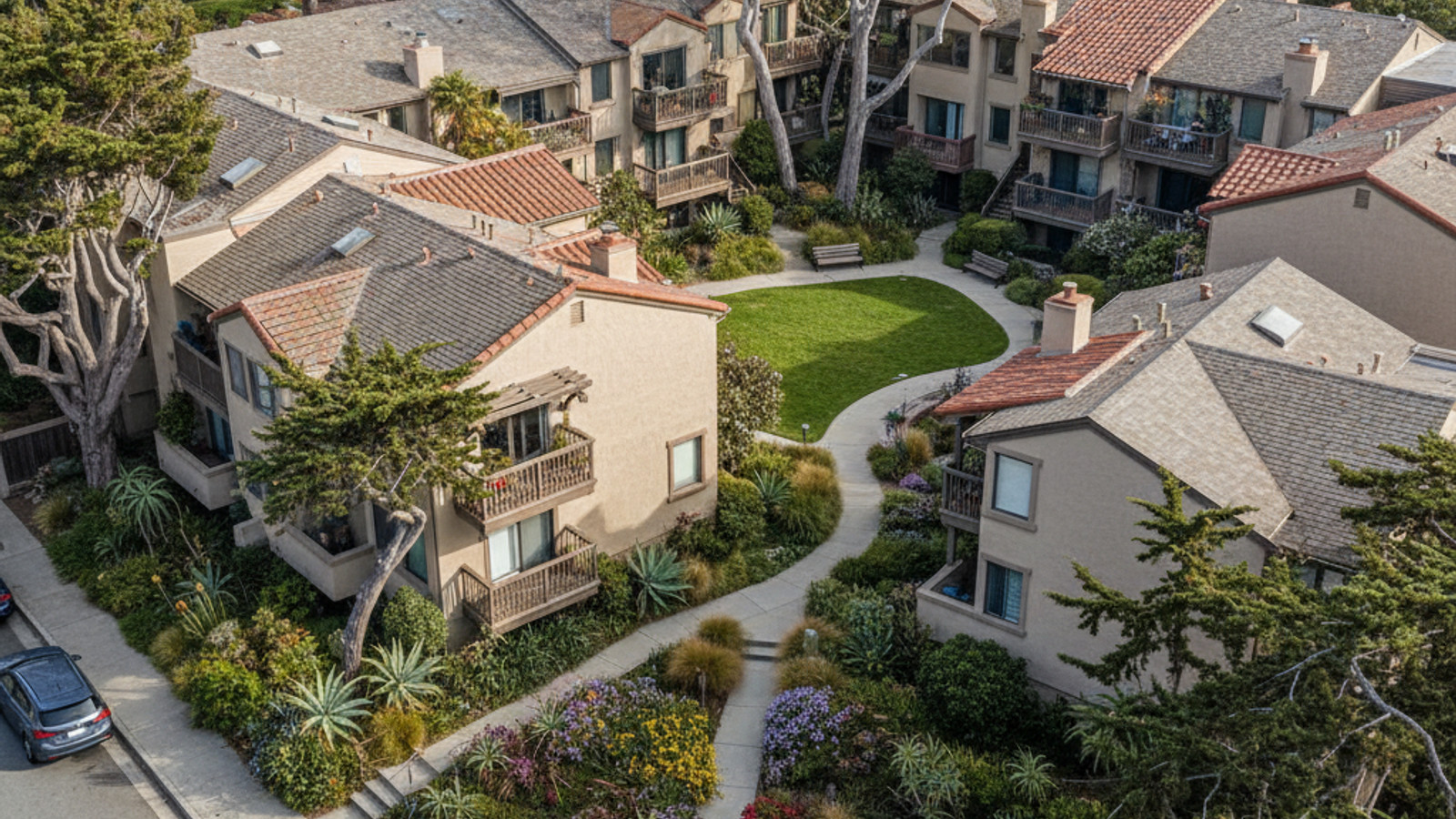
Purchasing a home in a coastal California market requires careful financial planning well beyond the initial purchase price. For buyers looking at condominiums and townhomes for sale in Santa Cruz, monthly carrying costs can significantly alter your purchasing power.
Understanding the landscape of HOA fees Santa Cruz CA is critical for mapping out a realistic housing budget. These monthly dues vary wildly depending on proximity to the ocean, the age of the complex, and the specific amenities provided to residents.
The Average Range of HOA Fees in Santa Cruz, CA
Monthly homeowner association dues in the Santa Cruz area currently range from the low $200s to well over $1,000 per month. This wide spread reflects the diverse inventory available across the county. A buyer looking at a modest complex slightly inland will face a vastly different financial reality than someone purchasing an oceanfront unit.
Baseline fees are typically found in inland developments, such as the Brommer corridor in Live Oak. These properties often feature fewer common areas and lower insurance premiums, keeping the monthly financial burden relatively manageable. Buyers prioritizing a lower monthly payment often find the best value in these slightly removed locations.
Conversely, beachfront complexes near West Cliff Drive or the Seabright area command a significant premium. The tight inventory near the beach drives up base property values, while the harsh marine environment accelerates the need for exterior upkeep. Evaluating the median cost of HOA fees in your target area helps accurately calculate your monthly housing budget and loan qualification.
Comparing Costs Across Different Property Types
California condos follow the Davis-Stirling Act, meaning buyers own the interior unit and a shared interest in common areas. This legal framework dictates how associations collect dues and manage reserve funds for future repairs. Condominiums generally carry higher monthly fees because the association is responsible for the entire exterior structure and all shared grounds.
Townhomes present a slightly different scenario depending on how they are legally recorded. A townhome recorded as a condominium will have similar fee structures to standard condos, whereas fee-simple attached townhomes might have lower dues but require the owner to maintain the roof and exterior. Single-family homes in Santa Cruz rarely carry HOA fees unless they are located within specific gated developments.
What Do Santa Cruz HOA Dues Actually Cover?
Buyers often experience sticker shock when looking at monthly dues, but these fees consolidate several major expenses into one payment. Reviewing the specific inclusions for a complex is a necessary step during the escrow process. A higher fee does not automatically mean a property is overpriced if it includes robust coverage and excellent amenities.
The most significant portion of a coastal association’s budget goes toward master hazard insurance. Properties near the ocean require specific, expensive coverage for saltwater corrosion, wind, and potential earthquake risks. While the master policy reduces the individual homeowner’s insurance burden, buyers still need to secure an HO-6 policy for their specific interior unit.
Before closing on a property, your real estate agent should request the full HOA package and project budget. This documentation verifies that the board has adequate reserve funding for large upcoming projects like roof replacements or exterior painting.
- Exterior building maintenance and routine roof repairs.
- Landscaping for all common areas and shared walkways.
- Trash removal, water, and sometimes basic cable or internet.
- Upkeep for community pools, fitness centers, and gated entrances.
How New 2026 California HOA Laws Affect Your Budget
Recent legislative changes in California directly impact how homeowner associations operate, enforce rules, and collect funds. Buyers entering the market in 2026 need to understand these new legal frameworks to avoid unexpected financial surprises. Associations that fail to comply with state mandates often pass the resulting costs down to individual owners.
The most pressing issue for condo buyers is the January 1, 2026 deadline for SB 326. This law requires mandatory structural inspections for exterior elevated elements like balconies and wooden decks. Non-compliant complexes or those discovering severe structural issues may face immediate special assessments to cover the required repairs.
Other regulations focus on homeowner rights and daily living expenses. Assembly Bill 130 caps most non-safety HOA fines at $100 per violation, which restricts aggressive enforcement by overzealous boards. Additionally, SB 770 removes previous insurance hurdles for residents looking to install electric vehicle chargers in their designated parking spaces.
Budgeting for Housing Costs Beyond the HOA Fee
Total carrying cost matters far more than the initial list price when purchasing real estate. Combining the mortgage, escrow impounds, property tax, and HOA fee provides the true picture of your monthly financial commitment. Failing to account for all these variables can quickly stretch a buyer beyond their comfort zone.
Santa Cruz County property taxes are based on the assessed value at purchase, governed by the 1978 California Proposition 13. Buyers should expect their base property tax rate to sit between approximately 1.1% and 1.25% of the purchase price, depending on the specific tax rate area. This fixed percentage provides predictable long-term tax planning, even as market values fluctuate.
Overall housing costs also correlate heavily with proximity to major commute routes. Properties positioned for easy access to Highway 17 toward Silicon Valley or Highway 1 often command higher prices and subsequently higher baseline taxes. Buyers should also factor in an additional 1% of the home’s value annually for interior upkeep and appliance replacement not covered by the association.
Frequently Asked Questions
What is a reasonable HOA fee in California?
A reasonable fee depends entirely on the location, age, and amenities of the complex. Statewide averages generally sit between $300 and $600 per month for standard condominiums. However, coastal markets like Santa Cruz often see reasonable fees pushing closer to $700 or $800 due to elevated insurance and maintenance costs.
How do coastal hazards affect condo and townhome decisions in Santa Cruz, CA?
Coastal hazards drastically increase the master insurance premiums that associations must pay. Salt air corrosion, high winds, and cliff erosion force boards to allocate a larger percentage of monthly dues toward structural reserves. Buyers looking at properties along West Cliff Drive must budget for these environmental realities when reviewing the association’s financial health.
Where are California’s highest HOA fees located?
The highest monthly dues are consistently found in major metropolitan centers and exclusive coastal enclaves. Luxury high-rises in San Francisco and Los Angeles frequently charge well over $1,500 per month for premium amenities and concierge services. In Santa Cruz County, the highest fees are concentrated in oceanfront complexes where specialized hazard insurance dominates the budget.





Leave a Reply