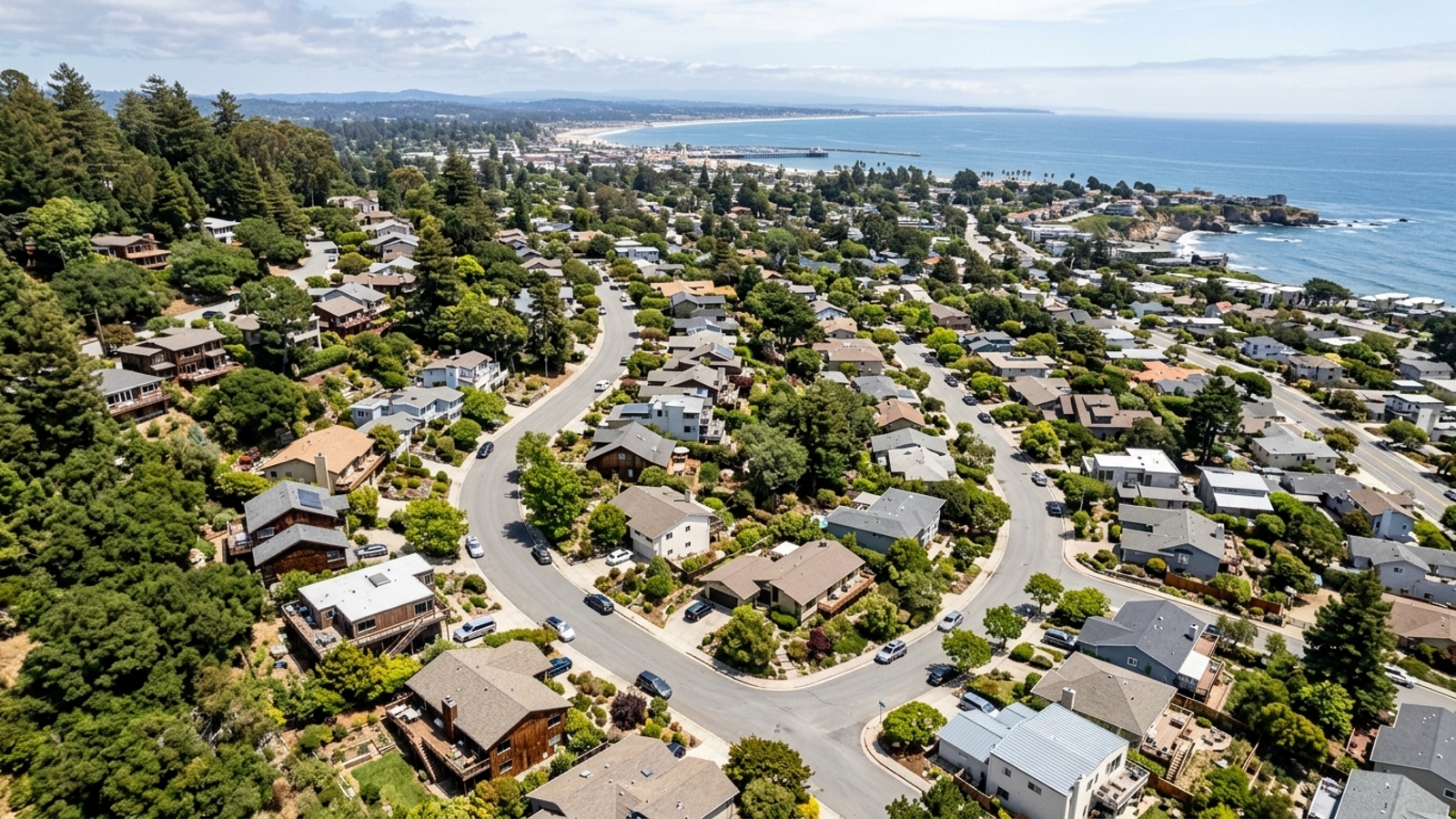
The median sale price for a home in Santa Cruz, CA is currently around $1,351,106. This market can be challenging for first-time home buyers in Santa Cruz. Financing a property at that price point means the interest rate on your loan will dictate thousands of dollars in annual carrying costs – and that gap compounds over thirty years in ways that can genuinely surprise people.
Rates are a moving target that rarely stay flat for long. Buyers and sellers both watch these numbers closely because they dictate local demand and individual purchasing power. Knowing how a percentage point translates into a monthly payment is the kind of thing that changes what you decide to do – and when.
Understanding Current Mortgage Rates in Santa Cruz
Interest rates are not a single, universal number that applies to every buyer. They fluctuate based on broad economic factors, inflation data, and the bond market. The rate you see advertised online is often a best-case scenario built around top-tier credit and a substantial down payment. Your actual rate depends on your financial profile and the lender you choose.
Where to Find Accurate Daily Rates
You won’t find your exact rate on a public dashboard or news site. To know what you qualify for today, you need a same-day quote from a lender or a formal Loan Estimate.
A Loan Estimate breaks down the exact interest rate, estimated monthly payment, and closing costs tied to your specific mortgage application. Pull these documents from a few different lenders and compare them side by side – that’s the only way to know the true cost of borrowing.
Why Rates Change Every Day
Mortgage rates track closely with the yield on 10-year Treasury bonds. When investors buy up bonds, yields drop, and mortgage rates tend to follow.
Economic reports on employment, inflation, and consumer spending cause those bond yields to shift daily. The rate a lender quotes you on a Tuesday morning might look different by Thursday afternoon.
How Interest Rates Impact Your Buying Power
Recent market data shows Santa Cruz homes selling in roughly 14 days, with properties averaging about 1.6% over the asking price. In a market that moves that fast, knowing your exact budget isn’t a nice-to-have – it’s a requirement.
Your buying power is the maximum home price you can afford based on your income, debts, and the current interest rate. As rates rise, a larger share of your monthly payment goes toward interest, which lowers the total loan amount you can comfortably carry.
Comparing Payments on a Santa Cruz Home
Consider a home priced near the recent Santa Cruz median of $1,351,106. Put 20% down and you’re financing roughly $1,080,000.
For illustration only: at a 6% interest rate, the principal and interest payment on a 30-year loan runs about $6,475 per month. At 6.5%, that jumps to around $6,826. At 7%, you’re at $7,185. One percentage point – no change to the purchase price, no change to the house – adds hundreds of dollars every single month.
Balancing Home Prices and Interest Rates
A lot of buyers try to time the market by waiting for rates to drop. The catch is that when rates fall, more buyers flood in, competition rises, and home prices follow. Higher rates do tend to cool demand, which can mean more inventory and fewer bidding wars – but you’re paying more to borrow.
Neither environment is obviously better. You have to weigh the cost of borrowing today against the real possibility of paying a higher purchase price later.
How Your Loan Type Shapes Your Rate
The type of mortgage you select directly influences the rate a lender offers you. Lenders price loans based on risk, and different loan structures carry different risk levels for the bank. Beyond your personal financial metrics, the length of the loan and any government backing it carries will both move your final number.
Choosing Between 15-Year and 30-Year Fixed Loans
A 30-year fixed-rate mortgage spreads payments over three decades, which keeps the monthly number lower. Because the lender waits longer to be paid back, these loans typically carry higher interest rates.
A 15-year fixed loan compresses that timeline, so the monthly payment is considerably higher. The trade-off is a meaningfully lower interest rate and substantial savings over the life of the loan.
When an Adjustable-Rate Mortgage Makes Sense
Adjustable-rate mortgages, or ARMs, start with a fixed interest rate for a set period – usually five, seven, or ten years – then adjust annually based on market indices. The introductory rate is often lower than a comparable 30-year fixed loan.
If you’re confident you’ll sell or refinance before the fixed period ends, it’s worth running the numbers to see if an ARM offers real upfront savings in your situation.
Differences Across Government and Conventional Loans
Conventional loans aren’t backed by the government and typically require stronger credit scores to reach the most favorable rates. FHA loans, backed by the Federal Housing Administration, often offer lower baseline interest rates but come with mandatory mortgage insurance premiums that add to the monthly cost.
VA loans are available to eligible veterans and active-duty service members and consistently offer some of the lowest rates on the market with no private mortgage insurance required. USDA loans provide favorable rates for rural properties, though most of the immediate Santa Cruz city limits don’t meet the rural designation requirements.
Securing a Lower Mortgage Rate
You can’t control the bond market. You can control the personal financial factors that lenders use to price your loan – and lenders reward borrowers who present the lowest risk of default. Taking the time to clean up your financial profile before you apply can shave real money off your rate and keep it off for the next thirty years.
Improving Your Credit Profile
Your credit score is the single biggest personal factor in your mortgage rate. Borrowers with scores above 740 generally qualify for the lowest rates available.
Pull your credit report, look for errors, and pay down high revolving credit card balances several months before you apply. Even a 20-point improvement in your score can push you into a better rate tier.
Using Down Payments and Points
A larger down payment reduces the lender’s risk, which often translates to a slightly lower rate. Putting down at least 20% also eliminates the need for private mortgage insurance on conventional loans.
You can also buy discount points at closing. One point typically costs 1% of your loan amount and lowers your interest rate by a set fraction, usually 0.25%. If you’re planning to stay in the home for a long time, calculate the break-even point to see whether buying down the rate makes sense for your situation.
Comparing Multiple Lenders
Rates vary from one institution to the next. Applying with a single lender means you might never know what better pricing was sitting across town. Request Loan Estimates from at least three different lenders on the same day, then compare them side by side – a stronger offer from one bank gives you something real to bring to the next conversation.
Locking in Your Rate
Once you find a favorable rate, a rate lock holds that percentage for a specific window, typically 30 to 60 days. That protects you if the market moves up while your loan is in underwriting.
If your closing gets delayed past the lock period, you may have to pay a fee to extend it. Some lenders offer a float-down option that lets you capture a lower rate if the market drops before you close, though that usually comes with an upfront cost.
Choosing a Local Mortgage Lender in Santa Cruz
The lender you pick dictates more than your interest rate – it directly affects your ability to close on time. In a market where properties spend just 14 days on average before going under contract, a reliable lender isn’t a minor detail.
Sellers and listing agents in Santa Cruz County look carefully at the pre-approval letter that comes in with an offer. A letter from a lender with a local track record consistently carries more weight than one from an out-of-state call center.
The Value of a Local Mortgage Professional
Local lenders understand the nuances of the Santa Cruz market – specific coastal property insurance requirements, condo association rules, the quirks that come up around here. They also have established reputations with local real estate agents, which matters when things get complicated.
When you go with a national call center, your file often gets passed between multiple processors in different time zones. A local loan officer is directly accountable to you and reachable when something comes up mid-escrow.
Questions to Ask Potential Lenders
Before you commit to anyone, ask about their average closing timeline. You need to know whether they can comfortably close a loan in 21 to 30 days to keep your offer competitive. Ask about their communication style and weekend availability too. Real estate doesn’t pause on Saturdays, and you need a lender who can update a pre-approval letter on short notice when you’re ready to move on a property.
Comparing Banks, Brokers, and Credit Unions
Retail banks offer their own loan products and handle everything in-house. If you already have a relationship with a large bank, they might offer relationship discounts – but their baseline rates aren’t always the most competitive.
Mortgage brokers don’t lend their own money; they shop your application across dozens of wholesale lenders to find the best rate and terms. Credit unions operate as member-owned nonprofits and frequently offer very competitive rates and lower fees, though their product lineup may be narrower.
What Interest Rates Mean for Santa Cruz Sellers
Sellers need to watch mortgage rates just as carefully as buyers do. The cost of borrowing directly shapes how many people can qualify at your asking price.
With the median sale price in Santa Cruz sitting around $1,351,106, even minor rate fluctuations shift the pool of qualified buyers. That’s not abstract – it shows up in your showing activity and your offer count.
How Rates Influence Buyer Demand
When rates dip, buyer purchasing power increases. That typically means more showings, faster offers, and a higher likelihood of bids coming in above asking price.
When rates climb, buyers are working with tighter monthly budgets. Some pause their search entirely; others shift focus to lower price tiers. Either way, that can translate to fewer showings and longer days on market for your listing.
Pricing Your Home for the Current Market
Accurate pricing always matters, but it becomes critical when borrowing costs are elevated. Overpricing when buyers are already stretched thin on rate tends to leave a property sitting – and a listing that lingers develops its own problems.
Work with your agent to analyze recent comparable sales and current inventory levels, which recently sat at about 63 available homes. Pricing correctly from day one attracts the buyers who are active and qualified right now.
Frequently Asked Questions About Santa Cruz Mortgage Rates
What are mortgage rates today in Santa Cruz, CA?
Rates change daily and depend on your credit score, down payment, and loan type. To get an accurate number for your specific situation, request a same-day quote or a Loan Estimate from a lender.
Should I wait for rates to drop before buying a home in Santa Cruz?
It depends on your personal timeline and budget. Waiting for lower rates can increase your buying power, but it often brings more buyers into the market, which can drive up home prices and increase competition.
How much does a 1% difference in mortgage rate cost me?
A 1% difference changes your monthly payment by hundreds of dollars. For illustration only: on a $1,080,000 loan, moving from a 6% to a 7% rate adds about $710 to the monthly principal and interest payment.
How do I get the best mortgage rate as a buyer in Santa Cruz?
Improve your credit score, save for a larger down payment, and compare Loan Estimates from at least three different lenders. Borrowers with scores above 740 generally see the most favorable pricing.
How do I choose a local mortgage lender in Santa Cruz, CA?
Look for a lender with a strong reputation for closing on time and communicating well on weekends. Compare retail banks, credit unions, and mortgage brokers to find the best combination of low rates and reliable service.
How do current mortgage rates affect me if I’m selling my house in Santa Cruz?
Higher rates reduce buyer purchasing power, which can lead to fewer showings and less aggressive bidding on your home. Lower rates tend to bring more buyers into the market, increasing demand for your listing.
What happens if rates drop after I lock in my mortgage for a Santa Cruz home?
With a standard rate lock, your rate stays fixed even if the market drops. Some lenders offer a float-down provision that lets you capture the lower rate before closing, though that usually requires paying an upfront fee.
Planning Your Next Move in Santa Cruz County
Understanding the Santa Cruz real estate market takes more than knowing where rates are today. You need a clear picture of how those rates interact with local home prices and the current inventory – and that picture changes.
Talking with a local real estate agent early in the process helps you build a realistic budget before you’re under any pressure. A knowledgeable agent can also connect you with trusted local lenders who have a proven track record of closing loans smoothly in Santa Cruz County.

Leave a Reply